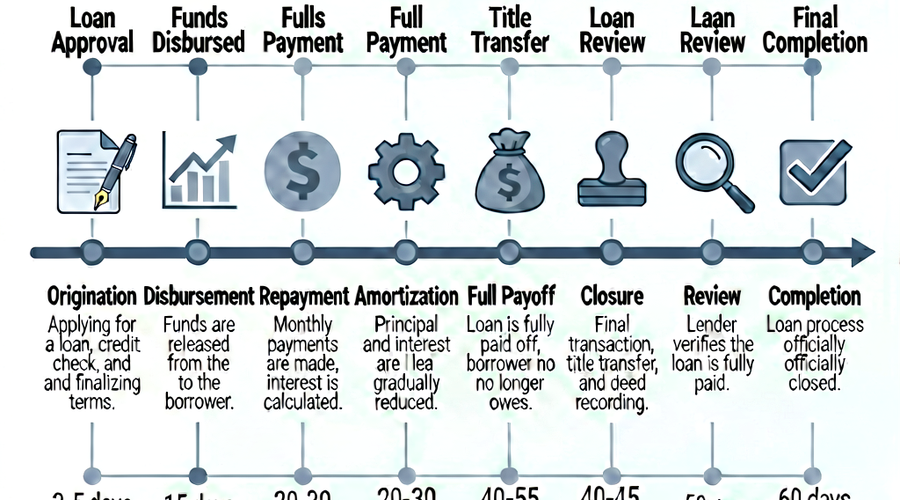
What Is Amortization? How Loan Payments Are Structured
Amortization is the process of paying off a loan through scheduled payments. Learn what it means, how it applies to mortgages, auto loans, and student loans.
- amortization
- what is amortization
- loan basics
- mortgage
- financial education
This article is for educational purposes only. It does not constitute financial or legal advice. Consult a licensed financial professional or HUD-approved housing counselor before making mortgage decisions.
If you have ever taken out a mortgage, car loan, or student loan, you have encountered amortization — even if no one used that word to describe it. Amortization is the mechanism that determines how each of your monthly payments is divided between interest and principal, and how your balance declines over the life of the loan.
Understanding amortization helps you compare loan products, plan extra payments strategically, and know exactly where your money is going each month. This article explains what amortization is, how it works across different loan types, and why it matters to you as a borrower.
The Core Definition
Amortization (from the Latin admortire, “to kill off”) is the process of gradually paying off a debt through a series of fixed, scheduled payments. Each payment covers two components:
- Interest — the lender’s charge for providing the loan
- Principal — repayment of the original amount borrowed
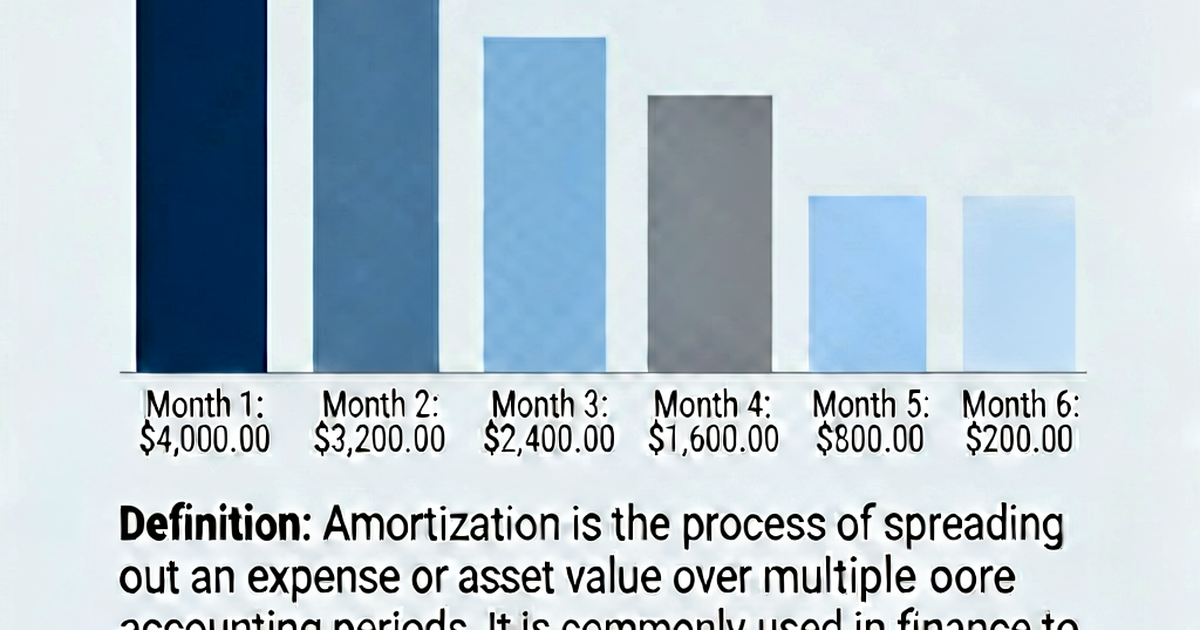
The defining feature of an amortizing loan is that, while the total payment stays constant, the split between interest and principal shifts over time. Early payments are weighted heavily toward interest; later payments are weighted heavily toward principal.
By the final payment, the loan balance reaches exactly zero. The loan has been “killed off.”
Why Payments Are Front-Loaded With Interest
Interest on most consumer loans accrues on the outstanding principal balance. The formula for the interest portion of any given month is straightforward:
Monthly Interest = Outstanding Balance × (Annual Rate ÷ 12)
When you first take out a loan, your balance is at its highest point — so interest is at its highest. As you pay down principal month by month, the balance shrinks, and the interest portion of each payment shrinks with it. The fixed payment amount stays the same, so the freed-up portion goes to principal.
This is not a quirk or a trick — it is a mathematical consequence of how interest accrues. The CFPB notes that in the early years of a mortgage, the majority of each payment goes toward interest rather than reducing your balance. (CFPB — What is amortization?)
Types of Loans That Amortize
Mortgage Loans
A mortgage is the most common — and highest-stakes — amortizing loan most people will ever have. A standard 30-year, fixed-rate mortgage amortizes fully over 360 monthly payments. Each payment is identical, but the interest/principal split changes every single month.
On a $300,000 mortgage at a 7% annual interest rate (example rate, not a current quote):
- Month 1 interest: $300,000 × (0.07 ÷ 12) = $1,750
- Month 1 principal: $1,995.91 (total payment) − $1,750 = $245.91
- Remaining balance after Month 1: $299,754.09
By Month 360, nearly the entire payment goes to principal.
Use our amortization calculator to generate a full schedule for your specific loan details.
Auto Loans
Auto loans typically amortize over 24 to 84 months. The mechanics are identical to a mortgage — fixed monthly payment, declining interest portion, increasing principal portion. Because auto loan terms are shorter, the shift from interest-heavy to principal-heavy payments happens faster.
Student Loans
Federal student loans amortize similarly to other installment loans. Under a standard 10-year repayment plan, each monthly payment is fixed and the loan fully amortizes by the end of the term. Income-driven repayment plans have variable payments and may not fully amortize the loan — in some cases, the balance can grow if monthly payments do not cover accruing interest.
Personal Loans
Personal loans from banks or credit unions are typically fully amortizing installment loans with fixed payments over terms ranging from 1 to 7 years.
Fully Amortizing vs. Non-Amortizing Loans
Not all loans amortize. It is important to understand the difference:
| Loan Type | Description |
|---|---|
| Fully amortizing | Fixed payments that pay off both principal and interest by the end of the term (most mortgages, auto loans, personal loans) |
| Interest-only | Payments cover only interest; principal balance does not decrease unless extra payments are made |
| Balloon loan | Lower payments during the term, then a large lump-sum “balloon” payment due at the end |
| Negative amortization | Payments less than accruing interest; unpaid interest is added to the balance, making it grow |
The Federal Reserve’s Consumer Handbook on Adjustable-Rate Mortgages notes that certain adjustable-rate mortgage products have historically allowed negative amortization, which can leave borrowers owing more than they originally borrowed. (Federal Reserve)
The Amortization Formula
The monthly payment for a fully amortizing loan is calculated using the following formula:
M = P × [r(1+r)^n] ÷ [(1+r)^n − 1]
Where:
- M = monthly payment
- P = principal (loan amount)
- r = monthly interest rate (annual rate ÷ 12)
- n = total number of payments
For a $300,000 loan at 7% over 30 years:
- r = 0.07 ÷ 12 = 0.005833
- n = 360
- M = $300,000 × [0.005833 × (1.005833)^360] ÷ [(1.005833)^360 − 1] ≈ $1,995.91
This single formula is the engine behind every amortization schedule. Once you know the monthly payment, you can compute every row of the schedule by applying the monthly interest formula and subtracting from the running balance.
Why Amortization Matters to Borrowers
1. Total Interest Cost
Because of how amortization front-loads interest, the total interest paid over the life of a loan can be substantial. On the $300,000, 7%, 30-year mortgage above, the borrower pays approximately $418,527 in total — more than $118,000 in interest on top of the $300,000 principal.
Choosing a shorter loan term or making extra payments can dramatically reduce this figure.
2. Equity Building
Home equity is the difference between your home’s value and your outstanding mortgage balance. In the early years of an amortizing mortgage, you build equity slowly because most of each payment goes to interest. Understanding this helps set realistic expectations for how long it takes to reach meaningful equity levels.
HUD encourages homebuyers to understand the full cost of homeownership, including how slowly equity builds in a standard amortization structure. (HUD — Buying a Home)
3. The Value of Extra Payments
Any extra payment made on a fully amortizing loan goes directly to principal, which immediately reduces the balance on which future interest is calculated. Even small additional payments early in a loan’s life can save thousands in interest and shorten the repayment term meaningfully.
4. Comparing Loan Products
When evaluating loan offers, looking at the amortization schedule — not just the monthly payment — reveals the true cost of each option. A lower monthly payment achieved through a longer term often means paying far more interest overall.
Getting Your Amortization Schedule
The best way to see exactly how any loan amortizes is to run the numbers. Our amortization calculator generates a complete, month-by-month schedule for any loan amount, interest rate, and term. You can also model the impact of extra payments to see how much time and interest you could save.
Understanding amortization is the foundation for making informed decisions about mortgages, refinancing, and loan payoff strategies — all topics covered in the other articles in this series.